Mountain West Jetting
Mountain West logoMountain West Hydro Jetting & Sewer Maintenance LLC

SEWER LINE REPAIR VS. SEWER LINE REPLACEMENT: HOW TO DECIDE BASED ON WHAT THE CAMERA SHOWS

Blog Article

Story by Mountain West Hydro JettingPublished June 18, 2026Repair Vs ReplacementServing Northern Utah and the Salt Lake corridor

Sewer Line Repair vs. Sewer Line Replacement: How to Decide Based on What the Camera Shows

A contractor tells you your sewer line needs work. The next question is not just "what kind of repair?" — it is "how much of the line should be replaced?" Repairing a 10-foot section costs less than replacing an 80-foot lateral, but only if the rest of the line is sound. If you repair one section and the adjacent pipe fails six months later, you paid for two jobs when one replacement would have handled both. This article gives you the decision framework: what the camera should show you, which findings point to repair, which point to replacement, and where the crossover happens.

Start Here

Here is the core tension: repair is cheaper than replacement, but only when the rest of the line does not need replacing too.

What This Article Helps You Do

  • Read camera findings and understand which ones point to repair vs. replacement
  • Apply the 50-percent rule to determine when replacement becomes more practical than multiple repairs
  • Factor in pipe material and age as indicators of remaining useful life
  • Know when partial replacement — replacing part of the line and leaving the rest — is the smartest middle path
  • Evaluate contractor recommendations against the camera evidence

Quick Takeaway

Repair makes sense when the damage is isolated to one location in an otherwise sound pipe. Replacement makes sense when the damage is widespread, the pipe material is at or past its expected lifespan, or repairing one section would leave you with a line that is likely to fail at the next weak point. The crossover is the 50-percent rule: if more than roughly half the line shows defects, replacement is almost always more cost-effective than cumulative spot repairs. The camera inspection is the tool that answers the question — without it, the decision is a guess.

Repair Vs Replacement

Here is the core tension: repair is cheaper than replacement, but only when the rest of the line does not need replacing too.

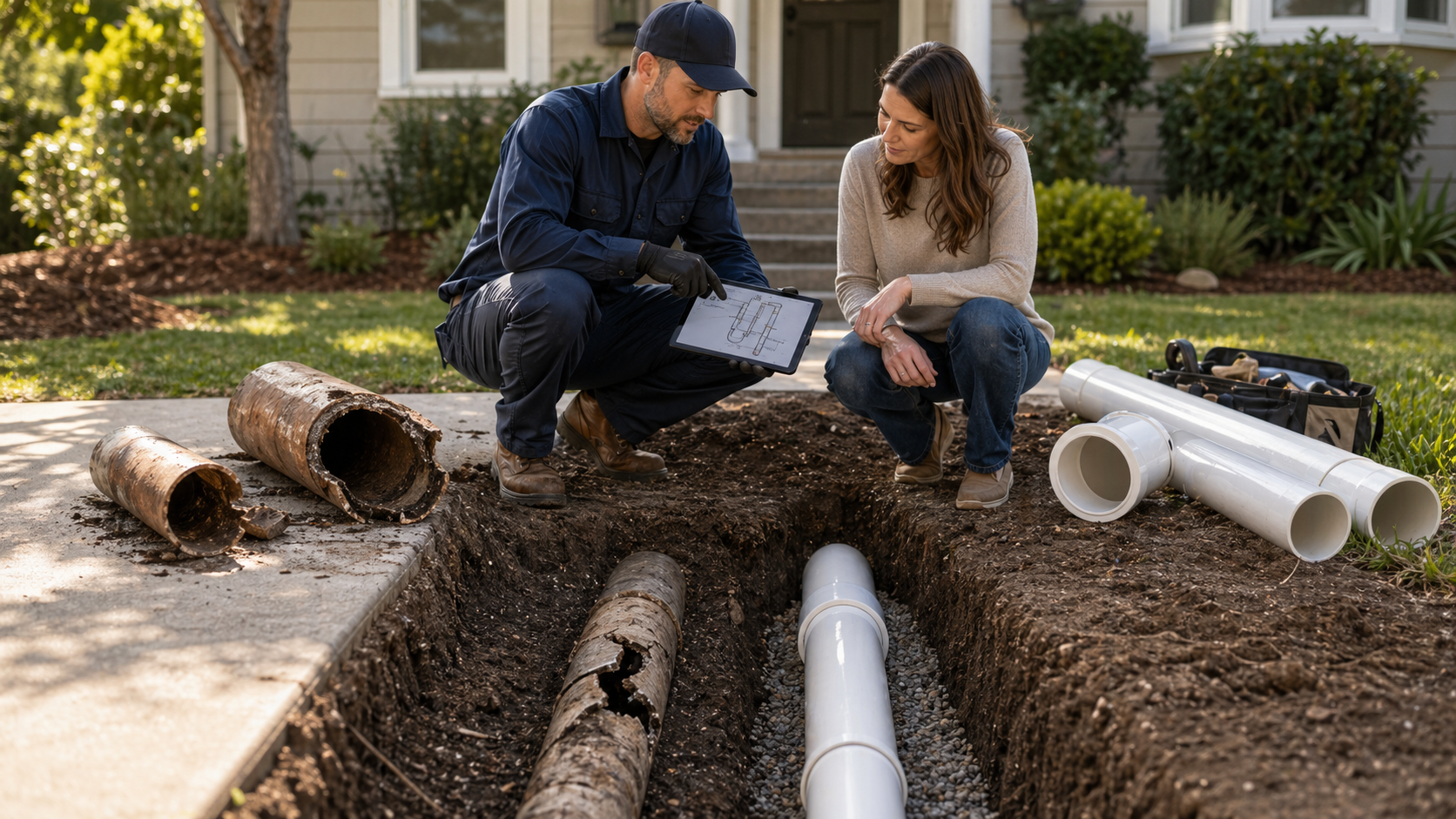
A spot repair at one damaged joint makes perfect sense if the rest of the lateral is PVC in good condition. It makes no sense if the rest of the lateral is 60-year-old clay with root intrusion at every joint — because you will be calling another contractor for the next failure within a year or two.

The decision is not "repair is cheaper, so repair is better." The decision is "given the condition of the entire line, which approach prevents me from paying twice?"

Where The Difference Shows Up

The Five Camera Findings That Drive the Decision Every repair-vs.-replacement decision comes down to what the camera shows along the full length of the line. Here are the five findings that matter most.

Start with the normal pattern: wastewater should move away from the fixture, through the branch line, into the larger building drain or sewer lateral, and out toward the public or private collection system. Most confusion starts when one symptom is judged without locating where that pattern is breaking down.

For sewer line repair and replacement questions, the useful first step is separating a local fixture issue from a deeper line condition, because those two situations can look similar at the surface but lead to different next steps.

  1. 1. How Many Defects — and How Far Apart Repair territory: One defect at one location. A cracked joint at 45 feet, a single offset at 30 feet, a root mass at one entry point. The rest of the line is clean and structurally intact. Spot repair targets the failure and leaves the healthy pipe in place.
  2. Replacement territory: Three, four, or five defects spread across the run. Root intrusion at multiple joints. Cracking at 20 feet, an offset at 45 feet, and early deterioration at 60 feet. When the camera shows a pattern of failure across the line rather than a single point, repairing each one individually adds up to more cost, more disruption, and more risk than replacing the lateral once.
  3. The judgment call: Two defects close together within 10 feet can often be handled with one repair section. Two defects 30 feet apart in a line that is otherwise sound may still be repairable — but the argument for replacement gets stronger with each additional failure point.
  4. 2. Pipe Material and Remaining Lifespan Not all pipe materials age the same way. What the camera shows about material condition — not just the visible defect — tells you how much useful life remains in the rest of the line.
  5. PVC installed after ~1985. Expected lifespan: 50 to 100+ years. If a PVC line has an isolated defect — a cracked fitting, a separated joint from soil movement, construction damage — the rest of the pipe likely has decades of life left. Repair is almost always the right call. Replacing a full PVC lateral because of one damaged joint would be like replacing a roof because of one missing shingle.
  6. Cast Iron common in Northern Utah homes built ~1940 to 1980. Expected lifespan: 50 to 75 years. Cast iron corrodes from the inside out. The camera will show internal scaling rust and mineral buildup that narrows the pipe, rough pipe walls, and thinning at the bottom of the pipe where water flows. If the defect is isolated and the rest of the pipe shows moderate scaling but intact walls, repair can work. If the camera shows heavy corrosion across the full length — thinning walls, flaking, or pitting throughout — the pipe is approaching the end of its useful life, and repairing one spot leaves you with a line that will fail elsewhere.
  7. Clay common in Northern Utah homes built before ~1970. Expected lifespan: 50 to 60 years, but highly variable based on soil conditions and joint integrity. Clay pipe itself is durable, but the joints are the weak point. Every joint is a potential root entry point. If the camera shows root intrusion at one joint with the remaining joints tight and clean, repair is reasonable. If roots have entered at multiple joints across the run, the joint system has failed — and replacing the line with modern PVC eliminates all the entry points at once.
  8. Orangeburg used ~1940s to 1970s. Expected lifespan: 30 to 50 years. Orangeburg is a bituminized fiber pipe that softens and deforms as it ages. If the camera shows Orangeburg in any condition, replacement is almost always the recommendation. The material is past its expected lifespan, it cannot be reliably lined the deformed shape produces a deformed liner, and spot repair leaves you with a pipe that will continue to deteriorate. Orangeburg is a replacement material, not a repair material.
  9. 3. Structural vs. Buildup Problems Repair territory: The defect is a buildup problem in a structurally sound pipe. Grease coating, scale accumulation, or root growth at one entry point — these can be cleaned hydro jetting strips them, and the pipe behind the buildup is intact. Repair — or even just maintenance cleaning — may be all that is needed.
  10. Replacement territory: The defect is structural. The pipe wall has collapsed, cracked through, shifted at a joint so far that realignment is impossible, or deteriorated to the point where it cannot hold its shape. Structural failure cannot be cleaned away. It can sometimes be lined CIPP if the pipe still holds a roughly round cross-section, but if the structure has failed completely, replacement is the answer.

What Usually Decides It

The gray zone: Root intrusion. Roots enter through structural defects cracked joints, pipe wall fractures, but the structural defect may be minor — a hairline crack at a joint that is otherwise solid. If the crack is small and the joint is stable, cleaning the roots and monitoring is reasonable. If the crack is widening, the joint has separated, or the roots have caused secondary damage, the structural failure is progressing and repair or replacement of that section is warranted.

The goal is to move from guesswork to evidence. Good decisions usually come from the same sequence: define the symptom, locate the likely part of the system, check whether the issue is repeating, and decide whether cleaning, inspection, jetting, or repair planning fits.

That sequence keeps the article useful before any service conversation happens. It helps readers ask better questions and makes it harder for a vague diagnosis to sound more certain than it really is.

  1. 4. Grade Problems Bellies A belly is a section of pipe that has settled below the correct slope, creating a low spot where water pools, debris collects, and blockages recur.
  2. Repair territory: One belly at one location, caused by localized soil settlement, with the rest of the line at correct grade. The belly section can be excavated and re-bedded at the proper slope without touching the rest of the line.
  3. Replacement territory: Multiple bellies, or a belly that extends across a long section of the run. If the line has settled in several places, the underlying soil condition is the problem — and re-grading one spot does not fix the settlement pattern. In Northern Utah, clay soil is a primary cause of bellies. Clay expands when wet and contracts when dry, and that cycle shifts pipe over years. If the clay has moved the pipe in multiple locations, the settlement is systemic, and replacing the line at the correct grade with proper bedding material is more reliable than spot-fixing each sag.
  4. Important: Neither CIPP lining nor pipe bursting corrects a belly. Both methods follow the existing pipe path. If the pipe sags, the liner sags with it, and the burst replacement follows the same grade. Only excavation corrects a belly — and if excavation is required at multiple points for grade correction, full replacement by excavation often makes more sense than multiple spot digs.
  5. 5. Previous Repair History Repair territory: The line has never been repaired before. This is the first defect. The rest of the line is in good condition. A single repair has a high probability of being the only repair needed for years.
  6. Replacement territory: The line has already been repaired once or twice. Previous spot repairs mean the line has a history of failure — and each new failure point confirms that the pipe as a whole is degrading. If the line has been repaired at 30 feet and is now failing at 55 feet, the pattern is clear: the pipe is aging out section by section. Replacing the lateral stops the serial failure cycle.
  7. The 50-Percent Rule This is the practical threshold most experienced contractors use to guide the repair-vs.-replacement recommendation:
  8. If more than approximately 50 percent of the lateral shows defects — active damage, advanced deterioration, multiple root entry points, grade problems, or conditions that will require repair within the next 5 to 10 years — replacement is almost always more cost-effective than cumulative spot repairs.
  9. Here is why. A residential lateral in Northern Utah is typically 30 to 100 feet long. If 40 feet of an 80-foot lateral have defects, you are looking at either:

Details That Change The Comparison

Multiple spot repairs that each require access, equipment, labor, and restoration — and leave you with 40 feet of aging pipe between the repaired sections, or One replacement that addresses the entire line, gives you 50+ year pipe material PVC or HDPE, eliminates all current and future defect points, and involves one round of restoration instead of several. Below the 50-percent threshold, repair usually wins. Above it, replacement usually wins. Right at the line, the pipe material and remaining lifespan tip the balance — PVC at 50 percent damage is more likely a repair case the material has decades left. Clay or cast iron at 50 percent damage is more likely a replacement case the material is aging and the remaining sections will follow.

Small details often change the interpretation. Which fixture backed up first, whether more than one drain is affected, whether the problem returned after clearing, and whether there is odor or standing water all matter.

Use these notes to describe the issue clearly. A good description is often the difference between booking a narrow cleaning visit and starting with inspection or a broader sewer conversation.

  1. When Partial Replacement Is the Smartest Option Repair and replacement are not the only two choices. Partial replacement — replacing a section of the line while leaving the rest — is often the most practical path.
  2. When it makes sense: i The camera shows damage concentrated in one stretch say, 20 to 50 feet with the remaining pipe in good condition and a different material older section is clay, newer section near the house is PVC from a previous repair or remodel. ii The damaged section runs under a yard easier excavation but the healthy section runs under a driveway or sidewalk more expensive and disruptive to access. Replacing only the damaged section avoids unnecessary surface restoration costs. iii A previous repair created a transition point where the new pipe connects to the old. If the old pipe on one side of the transition is failing but the repaired section is sound, replace only the failing side.
  3. When it does not make sense: i The remaining "healthy" section is clay or cast iron approaching the end of its expected lifespan. Leaving 30 feet of 60-year-old clay in the ground while replacing 50 feet adjacent to it creates a future problem at the transition. ii The line is short enough under 40 feet that the cost difference between partial and full replacement is minimal. At that length, full replacement eliminates all risk for a small incremental cost.
  4. Northern Utah Pipe Material by Construction Era When the camera shows you the pipe material, this context tells you how much life the rest of the line likely has — which is the core input for the repair-vs.-replacement decision.
  5. Pre-1940: Clay is most common. Some early concrete pipe. These lines are 85+ years old and are almost always replacement candidates regardless of the specific defect, because the material has exceeded its expected useful life.
  6. 1940 to 1970: Mix of clay and cast iron. Orangeburg appears in this era as well, particularly in lower-cost construction. Clay joints are the primary failure point. Cast iron corrosion is progressing. Any Orangeburg is a replacement.
  7. 1970 to 1985: Transition era. Cast iron, early PVC, and some remaining clay depending on the builder. Lines from this era are 40 to 55 years old — approaching the end of expected life for cast iron and clay, but potentially decades of remaining life for PVC.
  8. Post-1985: PVC is standard. These lines are under 40 years old with an expected lifespan of 50 to 100+ years. Unless the pipe has been physically damaged construction impact, extreme soil movement, improper installation, an isolated defect in a PVC line is a repair, not a replacement.
  9. How to find your home's build year: The county assessor's office maintains property records that include the year built. In Weber County, this is available through the Weber County Assessor's website. In Davis County, through the Davis County Assessor. The build year is not a guarantee of pipe material — remodels and additions may have replaced sections — but it is the best starting point before a camera inspection confirms.

How We Help Narrow It Down

When you call Mountain West at 801-317-8104 or email [email protected] because you are trying to decide between sewer line repair and sewer line replacement, here is where we fit.

This is where the article connects back to real service work. The point is not to turn every concern into the biggest possible job; it is to match the symptom pattern to the least confusing next step that can actually answer the question.

Tying the topic back to sewer line repair and replacement keeps the advice grounded. The work should explain what was found, what is still uncertain, and why the recommended next step fits the evidence.

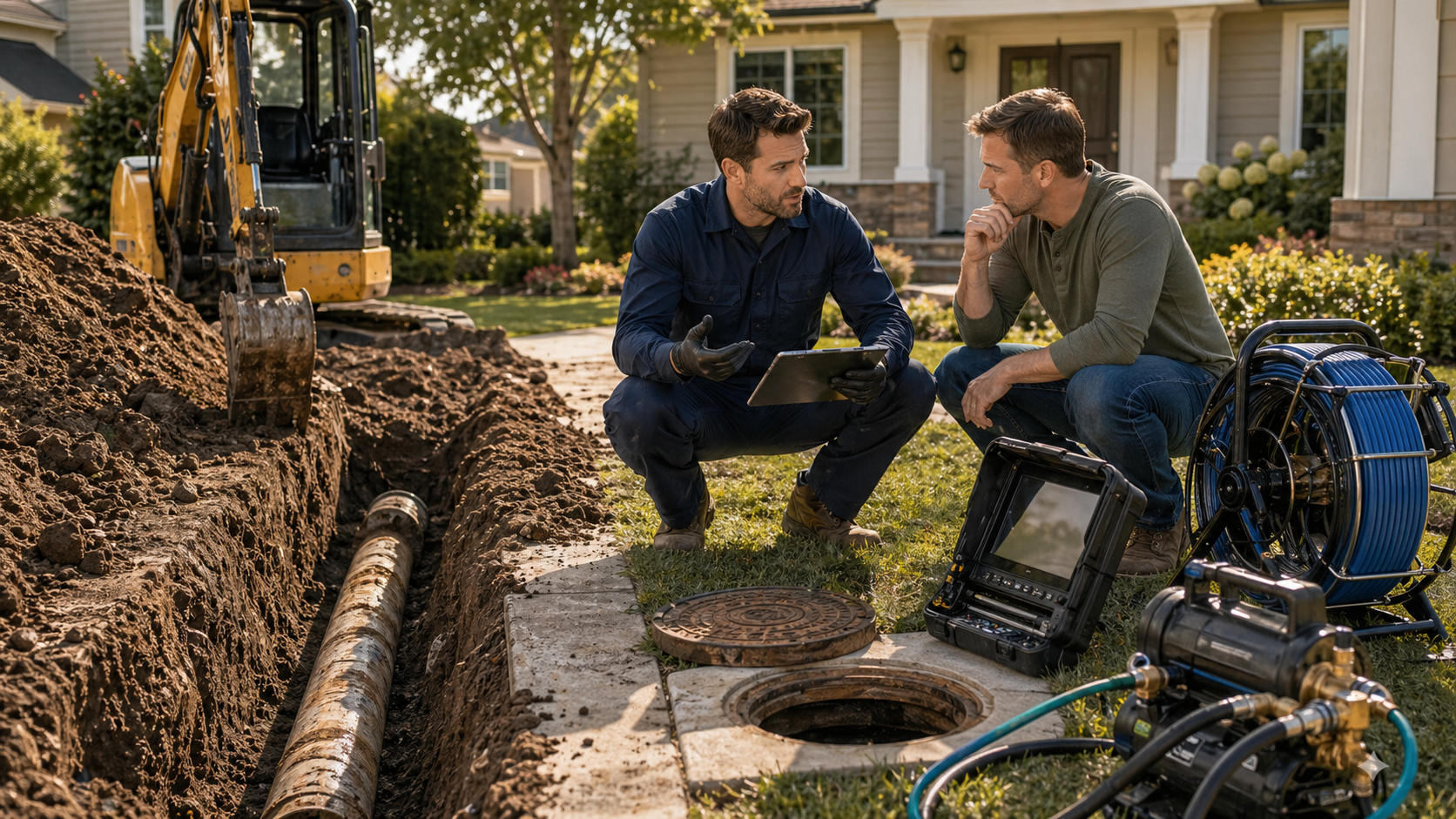
  1. Camera inspection. We run a sewer camera rated to scope up to 200 feet of pipe with live video review. The camera travels the full length of the lateral — not just to the first defect. You see every foot of pipe on screen with us. We identify pipe material, damage type, damage locations measured in feet from the cleanout, and the overall condition of the sections between the defects.
  2. Full-line assessment. The repair-vs.-replacement decision depends on the condition of the entire line, not just the damaged section. We inspect the full run so you know whether the rest of the pipe is sound or whether it is showing early signs of the same failure. That assessment is what separates a confident repair recommendation from a guess.
  3. Pre-inspection cleaning. If heavy buildup or an active blockage obscures the camera's view, we clear the line first. Our hydro jetting unit operates at 3,850 PSI and 8 GPM with 300 feet of hose — lines 2 to 12 inches. Our cable machine has 100+ feet of reach. After clearing, the camera shows the pipe condition behind the buildup.
  4. Plain-language explanation. We show you the footage and explain what each finding means for the repair-vs.-replacement decision. We tell you how many defects we found, where they are, what the pipe material is, and what the rest of the line looks like. We apply the decision framework from this article to your specific line so the recommendation is tied to evidence.
  5. Repair path guidance. We do not perform excavation or trenchless installation. But we identify the problem precisely — what is wrong, where, how extensive, and what method fits — so you go into contractor conversations knowing exactly what the line needs. We can also perform post-repair camera inspection to verify the work independently.
  6. Pricing. Inspection and cleaning visits are quoted based on line length, access, and severity. Emergency and after-hours calls carry a 15 to 35 percent premium 25 percent standard. Call for a quote.

Talk Through The Tradeoff

These follow-up questions keep the comparison honest. The goal is not to crown one option as "always better," but to show which facts make one path fit better than another.

When the topic is repair vs replacement, the next questions usually come down to condition, access, disruption, repeat-risk, and whether inspection has already confirmed the problem.

If I repair one section, how long before the next section fails?

It depends entirely on what the camera shows in the rest of the line. If the remaining pipe is PVC in good condition, you may never need another repair. If the remaining pipe is 50-year-old cast iron with visible corrosion throughout, the next failure could be 1 to 5 years away. That is why the camera must inspect the full line — not just the damaged spot. The condition of the pipe between the defects is the information that answers this question.

Is full replacement always more expensive than repair?

It costs more upfront, but not always more over time. A spot repair on an isolated defect in a healthy PVC line is genuinely cheaper — one repair, one payment, done. A spot repair on an aging cast iron line that fails again in 18 months at a different location means two mobilizations, two excavations, two restorations, and two bills. At that point, one replacement would have been less total cost, less total disruption, and would have eliminated all remaining failure points. The repair-vs.-replacement math is only accurate when it accounts for the probability of the next failure.

Can I get a repair now and plan for replacement later?

Yes — and this is sometimes the smartest move. If one section has failed but you are not financially ready for full replacement, a spot repair restores function and buys time. The key is knowing that you are buying time, not solving the problem permanently. Set the expectation: the repair handles this failure, but the rest of the line has a limited remaining lifespan, and replacement should be budgeted for within a defined timeframe. A post-repair camera inspection at 12 to 18 month intervals monitors whether the remaining pipe is holding or deteriorating.

Does insurance cover sewer line repair or replacement?

Standard homeowner's insurance typically does not cover sewer line repair or replacement due to age, wear, or root intrusion — these are considered maintenance issues, not covered events. Some insurers offer a sewer line rider or service line coverage as an add-on for an additional annual premium. If your home has older pipe and no coverage, ask your insurance provider about a service line endorsement before you need it. If a sewer backup causes interior property damage flooring, drywall, personal property, that damage may be covered under your standard policy depending on the cause — but the pipe repair itself usually is not.

What if two contractors give me different recommendations — one says repair, the other says replacement?

Ask each one to tie their recommendation to the camera evidence. "What specific findings in the footage support your recommendation?" If one contractor inspected the full line and the other only inspected to the first defect, the contractor with the full inspection has better information. If both inspected the full line and still disagree, the disagreement is usually about where to draw the repair-vs.-replacement line on a borderline case. Use the 50-percent rule and the pipe material context from this article to evaluate which recommendation fits the evidence more closely. If you are still unsure, a third opinion from an independent inspector not a repair contractor removes the potential bias.

Read This Next

These articles stay close to the same decision without repeating this one. Use them when the symptoms, timing, or service path points in a slightly different direction.

Source Log

These sources were used for background, claim checking, or local context. The article explains the topic in Mountain West's own words and does not copy outside article structure or long passages.

U.S. Environmental Protection Agencyparaphrased

Sanitary Sewer Overflows (SSOs)

Supports: Sanitary sewer overflows can back up into buildings, damage property, and create public-health concerns; sewer systems carry domestic and commercial wastewater to treatment facilities.

U.S. Environmental Protection Agencyparaphrased

Sanitary Sewer Overflow Frequent Questions

Supports: Common sewer blockage contributors include fats, oils and grease, wipes and other non-flushable products, roots entering defects, sediment, and other materials.

Ogden Cityparaphrased

Sewer Utility Information

Supports: Local Utah utility guidance can make the private-lateral responsibility clear: property owners may be responsible for maintenance and repair from the home to the city main, including tap connection, depending on jurisdiction.

Manual review note: Local ownership rules vary by city and utility. Treat this as regional context, not legal advice for every property.

Occupational Safety and Health Administrationparaphrased

Trenching and Excavation

Supports: Excavation decisions are also safety decisions; trench cave-ins are a serious hazard and protective systems such as sloping, shoring, or shielding may be required.

NASSCOparaphrased

Assessment

Supports: Internal television inspection is a major tool for assessing sewer-pipe condition and turning symptoms into documented findings.

International Association of Certified Home Inspectors InterNACHIparaphrased

Pipe Material Lifespans

Supports: Expected lifespan ranges by pipe material — PVC 50-100+ years, cast iron 50-75 years, clay 50-60 years, Orangeburg 30-50 years — used as general industry guidance for remaining useful life assessment.

Northern Steel Buildings & Construction, citing Utah Geological Surveyparaphrased

Expansive Clay Soils in Utah

Supports: Certain clay minerals in Utah soil can absorb water and swell significantly; the cycle of heaving and settling causes foundation and infrastructure movement.

Utah Division of Occupational and Professional Licensing DOPLparaphrased

S410 Specialty Contractor License

Supports: The S410 classification covers boiler, pipeline, waste water, and water conditioner contractor work under Utah Code R156-55a-301, authorizing sewer, sewer lines, sewage disposal, septic tank, and drainage work.

Related Next Steps

Next StepSewer Line Repair And ReplacementGo here if repair vs replacement points toward structural sewer repair instead of another cleaning-only visit.Next StepTrenchless Sewer RepairCompare no-dig repair options if repair vs replacement is moving past cleaning and into lower-disruption repair planning.Next StepGet A Free QuoteStart a free quote if you want service-fit or pricing guidance after this article.Next StepRead BlogCompare adjacent articles around repair vs replacement before you choose the next path.

More for You

Follow-up blog articles chosen for this page so the next question stays close to the same decision path.

Sewer Line Repair: What the Job Involves and What Drives the Cost article image for Sewer Line Repair And Replacement.Blog ArticleSewer Line Repair: What the Job Involves and What Drives the CostRead this next for another sewer line repair and replacement angle that builds on this article.Sewer Line Repair Near Me: What to Expect From Start to Finish article image for Sewer Line Repair And Replacement.Blog ArticleSewer Line Repair Near Me: What to Expect From Start to FinishRead this next for another sewer line repair and replacement angle that builds on this article.Trenchless Sewer Repair vs. Sewer Excavation: Which Method Fits Your Line? article image for Trenchless Sewer Repair.Blog ArticleTrenchless Sewer Repair vs. Sewer Excavation: Which Method Fits Your Line?Open this if you want the trenchless sewer repair side of the decision next.Sewer Line Repair: Warning Signs Your Pipe Needs More Than Cleaning article image for Sewer Line Repair And Replacement.Blog ArticleSewer Line Repair: Warning Signs Your Pipe Needs More Than CleaningRead this next for another sewer line repair and replacement angle that builds on this article.

Quick Answers About Sewer Line Repair vs. Sewer Line Replacement: How to Decide Based on What the Camera Shows

These are the quick answers most people want before they call, book, or decide on the next step.

What is this article about?

A contractor tells you your sewer line needs work. The next question is not just "what kind of repair?" — it is "how much of the line should be replaced?" Repairing a 10-foot section costs less than replacing an 80-foot lateral, but only if the rest of the line is sound. If you repair one section and the adjacent pipe fails six months later, you paid for two jobs when one replacement would have handled both. This article gives you the decision framework: what the camera should show you, which findings point to repair, which point to replacement, and where the crossover happens. It connects the topic back to sewer line repair and replacement when readers are trying to decide on the right next move.

Who is this article best for?

Here is the core tension: repair is cheaper than replacement, but only when the rest of the line does not need replacing too. It is most useful for readers trying to understand the issue before they book, compare services, or decide whether the symptoms point to a bigger sewer or drain problem.

What should I do after reading this article?

If the issue sounds familiar, the usual next step is to review the sewer line repair and replacement page or compare it with trenchless sewer repair before deciding whether to request a quote, book service, or call for faster guidance.

How can I reach Mountain West?

Mountain West Hydro Jetting serves Northern Utah and the Salt Lake corridor. You can reach us at 801-317-8104 or [email protected].